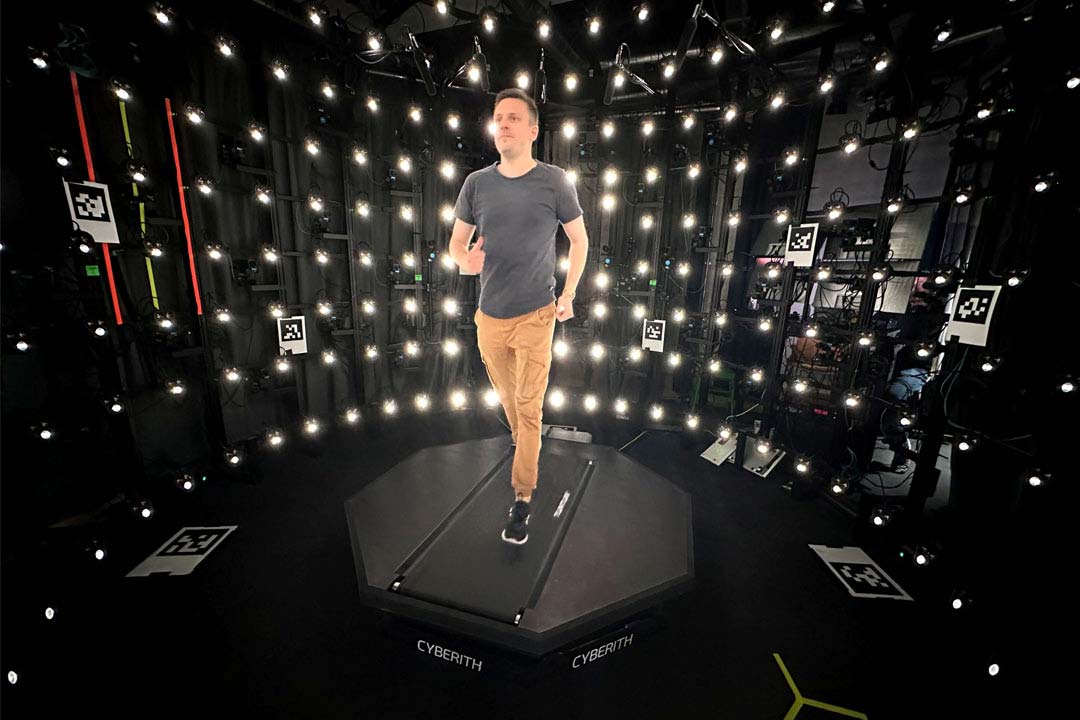
Clear Angle Studios has introduced a Volumetric Capture Rig designed for dynamic Gaussian splat capture, and is working with London VFX house Union on workflows for relighting captured performers and building digital crowds.
Gaussian splatting is a 3D capture and rendering technique that represents a person, object or environment as millions of tiny soft-edged points rather than as a traditional polygon model. The result can look very photorealistic, because it captures a lot of real-world surface detail, texture and lighting. The problem is that captured reality is not automatically useful reality. VFX teams still need assets that can be placed, adjusted, lit and composited inside a shot.
That is why the Union work is the interesting part. Union has been developing a pipeline with Clear Angle that uses Gaussian splats for digital humans and crowds, with a focus on making the captured assets relightable. In normal VFX terms, that means a captured performer should be able to sit inside a new CG scene and respond more believably to the lighting of that scene, rather than looking like a pasted-in recording from a different world.
Clear Angle’s rig is built for controlled studio capture of performances, including single performers, stunts, small groups and crowd elements. FXGuide reports that the system uses 40 synchronized machine-learning cameras in a half-dome configuration with integrated LED lighting, allowing performers to be captured under controlled, neutral lighting conditions. Clear Angle describes the rig as modular, so it can be adapted to different shoot requirements.
For VFX supervisors and post teams, the potential value is fairly specific. Crowd work and digi-doubles are expensive because believable human detail is hard: faces, hair, clothing, motion, lighting and shadows all have to survive close inspection. If Gaussian splat capture can preserve more of the original performance while still allowing relighting and compositing control, it could become useful for background crowds, mid-ground performers and some digital-double work.
The caveat is that this is still an emerging production workflow, not a universal replacement for traditional CG characters, motion capture or simulation. Gaussian splats can be extremely convincing, but the industry is still working through questions around editing, deformation, relighting, file handling, pipeline integration and shot-to-shot control.
Still, this is exactly the kind of development worth watching. It moves Gaussian splatting away from impressive tech demos and toward a practical VFX question: can captured human performances become flexible enough for production work without rebuilding every person from scratch?