What, exactly, are Gaussian splats?
Gaussian splatting sounds faintly ridiculous, which is unfortunate, because it is becoming genuinely useful in virtual production, shot planning and VFX. The short version: it can turn real-world locations into photoreal 3D scenes far faster than older methods, though it still comes with some catches.
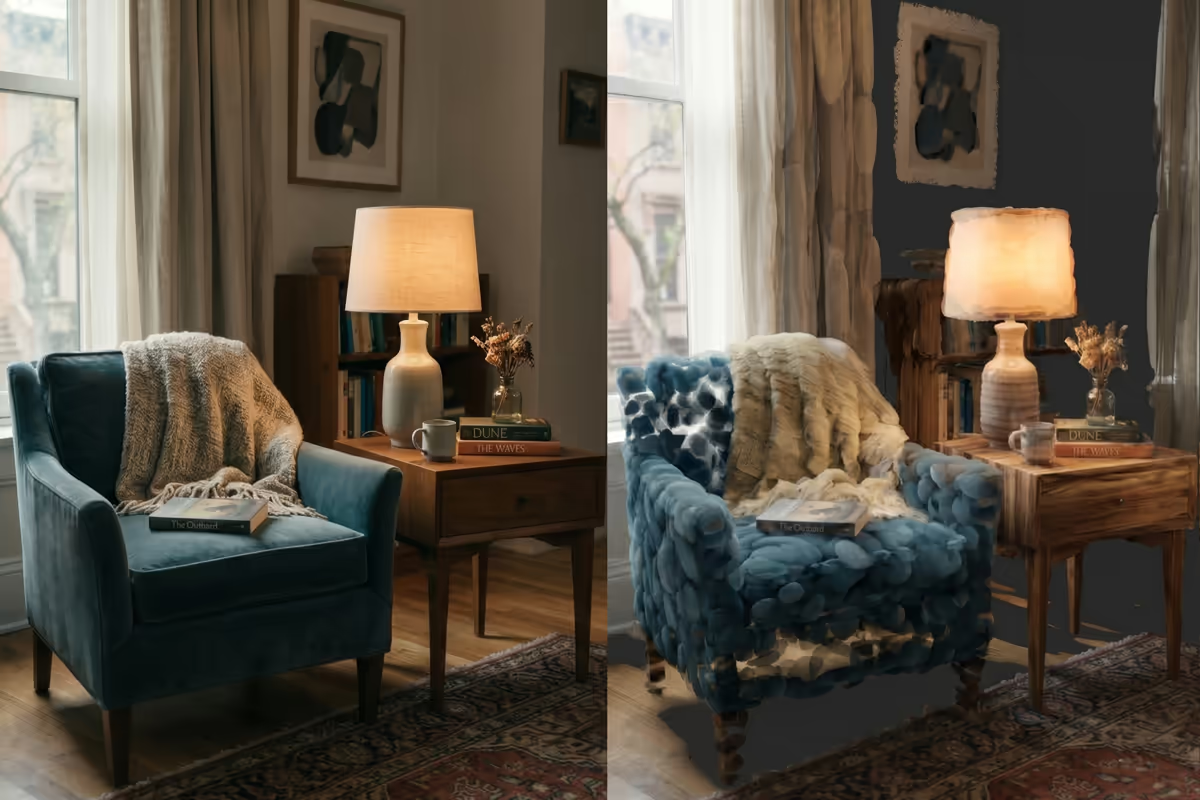
Quick Decoder
Plain-English Definition
Gaussian splatting is a way of turning lots of photos or video of a real place into a photorealistic 3D scene that you can move around inside.
Main Analysis
What a gaussian splat actually is
Gaussian splatting is a term that sounds oddly specific, but not especially enlightening. The plain-English version is this: it is a way to turn a lot of photos or video of a real place into a 3D scene that looks strikingly close to reality, and that you can move around inside in real time.
That matters because it does not just look like a rough scan or a game asset standing in for the real thing. At its best, it feels more like a piece of reality that has been captured, compressed and made navigable.
Technically, a gaussian splat scene is built from huge numbers of tiny soft shapes in 3D space. Think less solid points and more fuzzy little ellipses. Some can be small, some large, some stretched, some flattened. Each one stores information about where it is, how big it is, how transparent it is, and what colour it should appear from different angles. Layer enough of them together and you get something that can look uncannily real.
The result often feels less like a traditional 3D model and more like a walkable photograph. Slightly odd phrase, yes. Still probably the quickest way to explain why people are suddenly excited.
Why people in production should care
The reason gaussian splats are getting attention is that they solve a real production problem: how do you turn a real place into a usable digital scene without weeks of fixing errors, rebuilding bits of it and generally wrestling it into shape?
Traditional photogrammetry, which is the process of turning lots of photos of a real object or place into a 3D model, can do useful work, but it often comes with a lot of extra labour. You capture the thing, build the mesh, clean the mesh, project textures, fix the bits that went strange, then try to make it feel believable again. Gaussian splats can skip a good chunk of that pain.
If you need a location turned into something you can scout, review, use for previs, meaning rough visual planning before a shoot, place on a volume, or reference for VFX, this starts to look very appealing very quickly. Not because it replaces every other method, but because it gets you to a convincing result faster.
Why it looks more real than older scans
One useful way to think about this is that older scanning methods were often very good at capturing shape, but not as good at capturing how light actually behaves. And that is a big part of why some 3D scans look technically correct but still feel dead.
Gaussian splats belong to the broader family of radiance field techniques. In practical terms, that means they are not only trying to describe the surface of a thing, but also how it appears from different viewpoints. That is why they can handle view-dependent detail so well: sheen on a surface, reflections in glass, fine foliage, hair, little bits of visual complexity that tend to make conventional scans wobble.
This is also why people who first see a good splat often have the same reaction: hang on, why does this look more like a real place than a normal 3D scene?
The answer is not magic. It is just a smarter way of preserving the visual messiness of reality.
Where it fits best right now
The strongest use cases are the ones where realism matters more than deep editability.
Virtual production is an obvious one. A real location can be captured and turned into a believable digital environment far faster than building the whole thing by hand. Previs and techvis are another. Directors and supervisors can explore a location before a full crew ever arrives, and do it in something that feels much closer to the real place than a rough proxy.
It is also useful in post. Reflections, holdouts, set extensions and scene reference all become more interesting when the digital environment actually behaves like a dense visual record of the real location rather than a simplified approximation.
There is also a broader point here. Once you have captured a place this way, that asset can keep being useful. It can move from scouting to production to post instead of being rebuilt from scratch at every stage.
Why it is getting attention now
Part of the buzz comes from timing. Photogrammetry is established but can struggle with awkward materials. NeRFs made a lot of people excited because they could produce beautiful results, but they were slower, heavier and more awkward to use in real workflows.
Gaussian splats have landed in the middle ground people were hoping for. They keep much of the photoreal, view-dependent richness that made newer capture methods exciting, but they run far more comfortably in real time and fit more easily into production pipelines.
There is also something inherently persuasive about being able to open a scene in a browser or viewer, move around it freely, zoom in, and realise you are looking at a cloud of soft overlapping shapes that somehow still reads as reality. It is a strong demo because it is not just theoretical. You can feel the practical use almost immediately.
The catches, because there are always catches
The technology is good, but it is not magic.
First, lighting can still be a headache. A splat often carries a lot of the original lighting with it, which means dramatic relighting is not as flexible as it would be in a conventional CG pipeline.
Second, splats are not the same as solid geometry. They look volumetric, but they do not naturally behave like a proper mesh. So if you need robust physics, collisions, animation or heavy interaction, you are back in more familiar CG territory.
Third, capture discipline matters. Bad coverage, soft images, motion blur or missing angles will show up in the final result. You can get floaters, holes and mushy surfaces. Cameras are still not magic, and they still cannot see around corners.
So, is this hype or not?
Not really. At least not entirely.
Gaussian splatting feels like one of those rare newer technologies that is both genuinely impressive and actually useful. It can make reality capture feel less like a laborious reconstruction exercise and more like a direct path from the physical world to a workable digital scene.
That does not mean every production needs it tomorrow. But it does mean this is no longer just nerd-bait for graphics people. Teams in virtual production, previs and parts of post should probably be testing it now. Everyone else should at least know what it is, why it keeps coming up, and why some people are starting to talk about it less as a neat trick and more as a new medium for captured reality.
Which, for an explainer, is probably enough splatting for one day.
Where this could be heading
Five years from now, gaussian splatting could look less like a specialist trick and more like a normal part of working with 3D scenes. If the file formats settle down and browser support keeps improving, these assets should become much easier to move between tools, teams and platforms without everything turning into a faff. The bigger shift may come from 4D splats, which add time as well as space, making it possible to capture moving performances volumetrically and then reframe, relight or revisit them later in post. At the same time, generative tools will probably make it easier to create splat-based environments from prompts or reference images, which could shrink the time it takes to build worlds from scratch. If all of that happens, the real change is not that gaussian splats become flashy. It is that photoreal 3D scenes start to feel like ordinary working assets rather than expensive one-offs.
Deeper dive: a good video walkthrough
If you want a more visual, enthusiastic walkthrough of how gaussian splats work, this video is worth your time. I found it while researching this piece. It covers the basics well, then goes a bit further into 4D splats, which add movement over time and hint at where this technology could be heading next.
Further Reading