Agentic AI in Media Orchestration
AI agents are starting to move from chat windows into the machinery of media operations, where they can help route, tag, localize and check content. The useful version is less magic co-worker and more tightly governed workflow coordinator.
Quick Decoder
Plain-English Definition
Agentic AI in media orchestration means AI software that can plan and carry out approved multi-step media workflow tasks, such as finding, tagging, routing, localizing or checking content, instead of only answering a prompt.
Main Analysis
What it actually is
Agentic AI in media orchestration is AI used less like a chat window and more like a coordinator for work.
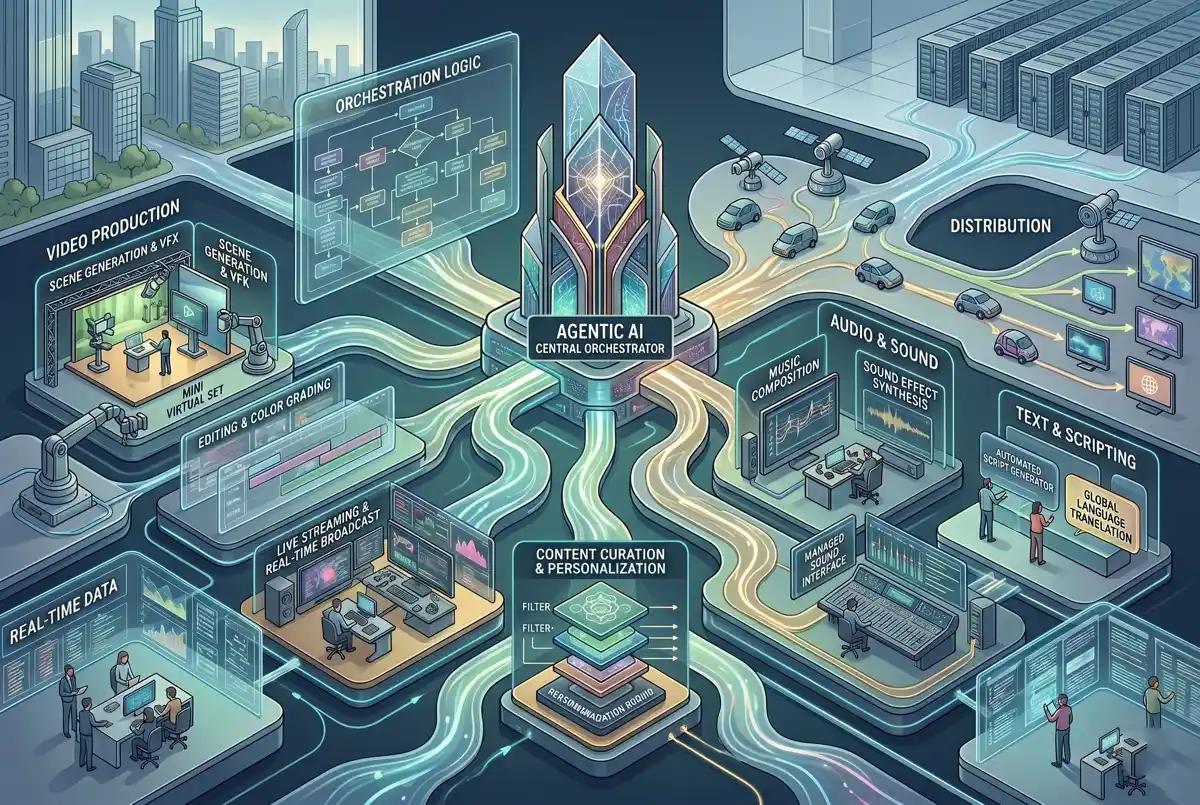
A normal generative AI tool can write a synopsis, suggest a title, translate a paragraph or create an image. An AI agent is meant to take a broader instruction, break it into steps, call other software tools, check the result and move the job along. In a media workflow, that might mean finding an asset, reading its metadata, sending it to a transcription service, asking for subtitles, triggering quality checks, routing the finished package to the right delivery folder and flagging anything that looks wrong.
The important word is not “AI.” It is “orchestration.” Media companies already have a lot of software: media asset management systems, transcoders, traffic tools, rights databases, localization systems, quality-control tools, cloud storage, ad systems and delivery platforms. The problem is that they often behave like neighboring kingdoms with terrible border control. Files move, metadata gets lost, someone retypes something, another person checks a spreadsheet, and the whole thing remains oddly fragile for an industry that can deliver live sport to a phone on a train.
Agentic orchestration tries to sit above or between those systems. It uses AI to interpret intent and context, then uses approved tools and application programming interfaces, or APIs, to do the work. An API is just a controlled way for one piece of software to ask another piece of software to do something.
That does not mean a cheerful robot is now running the broadcaster. In serious deployments, the agent should be boxed in by permissions, business rules, audit trails and human review. The useful version is not “AI does whatever it fancies.” It is “AI can carry out approved routine work without a person clicking through every step.”
Why people should care
This matters because media operations are becoming more complex while staffing and budgets are not expanding to match.
A single program may need different versions for streaming platforms, broadcasters, social clips, FAST channels, international partners, accessibility requirements, ad-supported windows and archive reuse. Each version can require different files, captions, language tracks, aspect ratios, artwork, metadata, compliance checks and delivery rules.
The boring work is often the expensive work. Not because each step is intellectually difficult, but because there are so many steps and so many chances for small errors to become expensive delays. Agentic AI is attractive because it promises to turn some of that manual coordination into goal-based workflow: “prepare this title for these partners” rather than “open this system, export that file, rename this version, check that field, upload it there.”
That is why the early media examples are clustered around supply chain work, asset discovery, localization, metadata enrichment, FAST preparation, marketing operations and quality assurance. These are areas where the job is structured enough for automation, but messy enough that old-style fixed scripts can become brittle.
Where it fits best right now
The strongest near-term fit is operational, not purely creative.
Media asset management is an obvious starting point. Vendors such as Dalet are positioning agentic interfaces as a way to let users search, discover and act on media libraries through natural-language requests. The promise is not just “find the clip,” but “find the right material and start the next workflow,” such as clipping, packaging or publishing inside the surrounding system.
Media supply chain orchestration is another practical area. SDVI’s next-generation Rally platform, for example, has been described around a declarative architecture. In plain English, that means users define the desired outcome and the platform works out more of the route. The phrase is dry enough to qualify as broadcast engineering, but the idea is useful: fewer hand-built workflow chains, more reusable rules and more room for AI-assisted configuration.
FAST and streaming operations also make sense. Amagi has announced agentic capabilities for tasks such as metadata enrichment, artwork generation, ad-break identification, captioning and localization. Those are exactly the sorts of repeatable media-preparation jobs that can clog a growing channel operation.
Localization is a more sensitive but important case. Deepdub has introduced what it calls an Agentic Dubbing Co-Worker for dubbing and localization workflows. The important caveat is that dubbing is not just word substitution. Timing, performance, character continuity and cultural context matter. AI can help organize and accelerate pieces of the process, but the sane version still keeps humans in the loop for judgment.
Quality assurance is another promising area, especially for streaming apps, FAST channels, smart TV apps and set-top-box testing. Traditional automated tests can break when a menu changes or a button moves. Agentic testing tools are pitched as more goal-based: the system tries to understand the screen, navigate it and report whether the user experience worked. This is useful, but it should be judged by failure rates, not demo charm.
Why it is getting attention now
Agentic AI is getting attention because generative AI alone has obvious limits.
A chatbot can summarize a rights document or write a draft promo description. Useful, yes. But media companies do not just need more text. They need files moved, checked, transformed, localized, packaged, enriched, routed and delivered. That requires AI systems that can use tools, not just answer questions.
The surrounding technology has also matured. Large language models are better at planning multi-step tasks than they were a few years ago. Cloud platforms now offer agent frameworks. Vendors are building orchestration layers, permission systems and monitoring tools. Media platforms are starting to wrap agentic interfaces around existing operational systems rather than treating AI as a separate novelty booth.
There is also a standards angle. SMPTE ST 2138, known as Catena, is an initiative to create a unified, secure and vendor-agnostic control plane for media systems. That matters because orchestration is only as useful as the systems it can safely control. But Catena should be treated as infrastructure work, not magic. A standard can make control more consistent; it does not automatically make autonomous control wise in every live production environment.
The catches
The biggest catch is that “agentic” is already being stretched by marketing departments until it makes a small cracking noise.
Some products described as agentic may be genuinely using AI to plan and call tools. Others may be traditional automation with fresher adjectives. The difference matters. A rule-based workflow can be excellent. It just should not be sold as a thinking co-worker if it is really a flowchart with a nice hat.
The second catch is governance. Agents need access to systems in order to be useful. That access creates risk. If an agent can search a library, change metadata, trigger deliveries or touch customer data, then it needs permissions, logs, approval paths and limits. The more useful the agent becomes, the more dangerous it becomes when badly configured.
The third catch is reliability. Media supply chains are not forgiving. A hallucinated summary is annoying. A wrongly routed master, a missing subtitle file, a rights flag ignored at scale or an incorrectly inserted ad break is a different class of problem. Agentic systems need deterministic guardrails: fixed rules that the AI cannot talk its way around.
The fourth catch is integration. A media-aware agent is only useful if it understands the systems, terms and constraints around the content. Broadcast and post workflows care about timecode, versions, codecs, language tracks, rights windows, delivery specs and approval status. Generic enterprise AI may not know which of those details can ruin someone’s week.
Is this hype or not?
It is both, annoyingly.
The practical idea is real. Media operations have too many repetitive handoffs, and AI agents are a plausible way to coordinate work across fragmented systems. The first useful wins are likely to be narrow: better archive search, quicker metadata enrichment, semi-automated localization preparation, smarter ad-break suggestions, workflow setup, delivery monitoring and exception reporting.
The overhyped version is the fully autonomous media supply chain that quietly runs itself while everyone goes for a long lunch. That may be a vendor slide, but it is not a responsible operating model for most companies.
The better phrase is “exception-based operations.” Let the system handle routine steps and surface the odd, risky or ambiguous cases to people. That is less glamorous than self-driving television, but it is much more believable.
Where this could be heading
The direction is toward media systems that are less about operating individual tools and more about managing outcomes.
A producer may ask for the best archive clips for a package. A localization manager may ask for a first-pass plan for ten territories. A channel team may ask for a library to be prepared for FAST distribution. An operations lead may wake up to a list of exceptions rather than a queue of ordinary files waiting for human button presses.
That could be genuinely useful. It could also create new problems: opaque decisions, over-dependence on vendors, messy permissions, staff deskilling and a fresh layer of infrastructure debt if every company builds its own half-understood agent platform.
The sane takeaway is this: agentic AI in media orchestration is worth watching and, in some operational areas, piloting. It is not mainly about replacing creative judgment. It is about reducing the amount of human life spent shepherding files through software that should have been on speaking terms years ago.
Further Reading